A practical deep dive for service business owners who are getting enquiries, messages, or bookings, but losing opportunities through missed calls, scattered DMs, and weak follow-up.
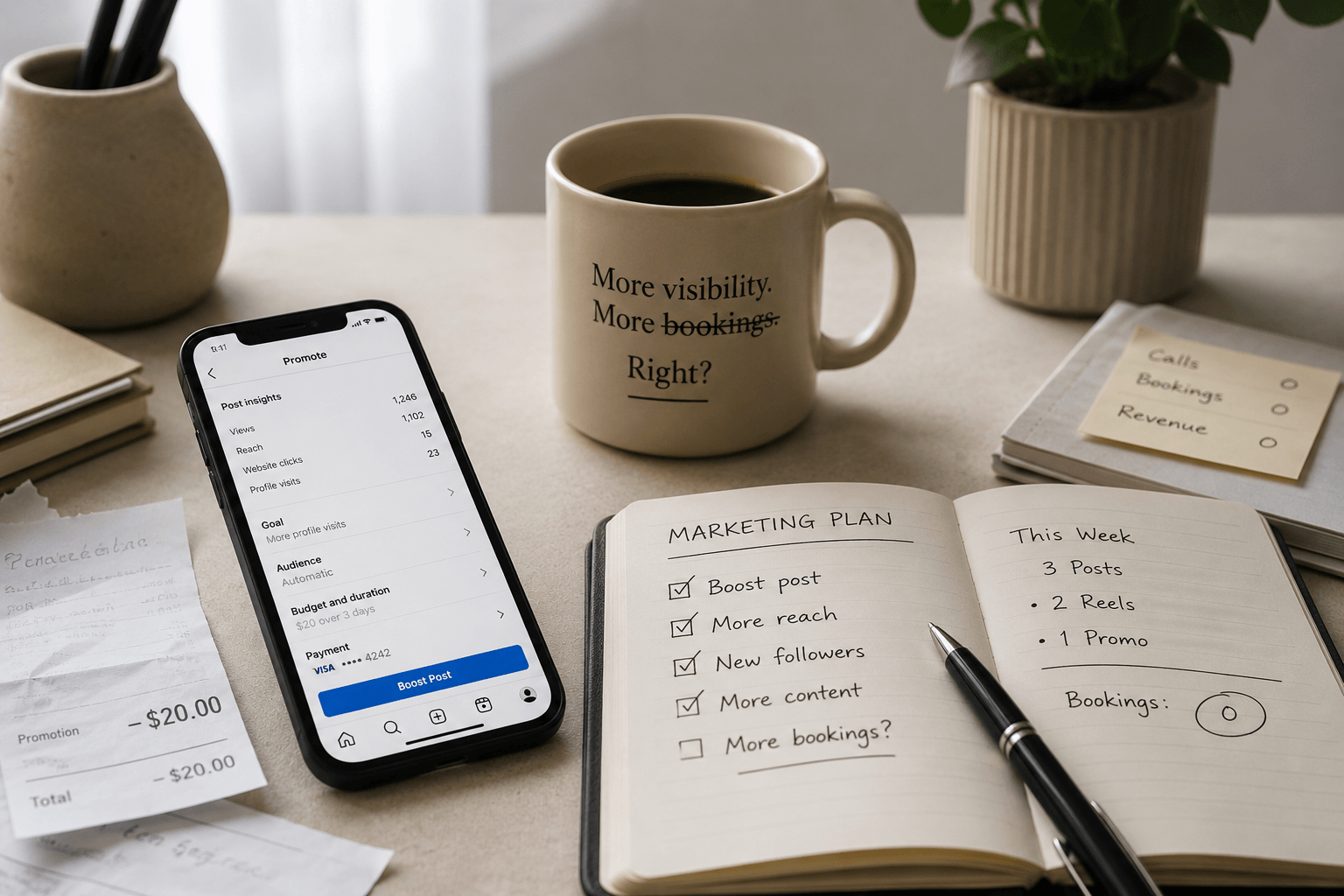
A lot of service business owners think they need more leads (potential customers).
More followers. More ads. More boosted posts. More people finding the page. More visibility.
And sometimes, yes, that is part of the problem.
But before you spend more money trying to get more attention, it is worth asking a much less glamorous question:
What is happening to the people who are already trying to reach you?
A business can have people calling, messaging, enquiring, asking questions, checking prices, clicking links, and showing interest, while still losing money every week because there is no proper system behind the interest.
That is the part many people skip.
The lead showed up. The business just did not catch it properly.
To back up for a second: a “lead” isn’t something complex. It is just a real person who raised their hand and said, “Hey, I’m interested in what you do.” They crossed over to become a potential customer the moment they gave you a way to contact them, whether that’s an email, a phone number, or a DM.
The problem is not always visibility
Visibility is easy to blame.
When bookings are slow or sales are inconsistent, the first instinct is often to assume that not enough people know about the business. So you as the owner start posting more, boosting more, trying to get more views, trying to get more reach, trying to be more visible.
That may help, but visibility only matters if the rest of the customer journey can handle the attention.
If someone calls and no one answers, what happens next?
If someone sends a DM and it gets buried, what happens next?
If someone asks for prices, says they will think about it, and goes quiet, what happens next?
If someone books once, has a good experience, and leaves, what happens next?
For many service businesses, the honest answer is: not enough.
There may be a reply when the owner has time. There may be a follow-up if someone remembers. There may be a booking link somewhere in the bio, a price list in a highlight, a phone number on Facebook, a WhatsApp button on Instagram, and a booking platform somewhere else.
But that is not the same thing as a system.
That is a collection of touchpoints.
A system makes sure interested people are captured, guided, followed up with, and invited to take the next step.
A missed call is not just a missed call
A missed call can feel small. You were busy. You were in an appointment. You were driving. You were serving another client. You were finally taking a much needed break.
That part is normal.
The issue is what happens after the call is missed.
For many businesses, nothing happens. The call sits in the call log. Maybe the person does not leave a voicemail. Maybe the owner sees it later and plans to call back. Then the day keeps moving, another message comes in, another client arrives, another task takes priority, and the call gets forgotten.
That person may not call again.
Not because your service was wrong. Not because your price was too high. Not because they hated the business. Sometimes they simply needed a result and the next business answered first.
For service businesses, that matters. A person calling is usually showing buying intent. They might want to book, check availability, confirm a detail, ask about a package, or find out how soon they can get help.
They have already taken a step toward you (they’re now a lead).
But a missed call with no follow-up system lets that moment disappear.
A better setup changes the outcome. The call is missed, but an automatic message goes out instantly. The person gets acknowledged. Their details are captured. The conversation stays open. The business owner or team can step in when it makes sense.
That does not require the owner to be glued to the phone all day. It means the business has a way to respond when the owner cannot.
DMs alone are not a lead system either
The same issue shows up in messages.
A potential client sends an Instagram DM asking for prices. Someone else WhatsApps to ask about availability. Another person comments under a post. Someone messages the Facebook page. Another person sends an email.
It feels like the business is getting interest, and it is. But interest does not automatically mean income.
Followers are not paying clients. Messages are not money. Questions are not bookings.
Those messages need somewhere to go.
If every enquiry stays inside the app where it came in, the owner ends up managing the business across scattered inboxes. WhatsApp, Instagram, Facebook, email, missed calls, comments, screenshots, notes, maybe a spreadsheet that was started once and never updated.
That is a lot to carry, especially on solo business owners.
The problem gets worse as attention grows. More messages do not automatically mean more bookings. Sometimes more messages just create more mess.
A proper lead flow answers a few simple questions:
Who is this person? What do they want? Where did they come from? What stage are they at? What should happen next? Who or what is responsible for making that next step happen?
That is the difference between a chat thread and a system.
A chat thread holds a conversation. A system moves the person forward.
Manual follow-up is a hidden leak
Even when a business does answer the enquiry, another problem often shows up: follow-up.
Someone asks about a service. You reply. They ask another question. You answer. They go quiet or you have to run off to do your work. Your hands are tied. You plan to check back in later, but the day gets busy and it never happens.
That is not unusual. Business owners are human. They get tired, booked up, pulled into client work, distracted, pulled into admin, pulled into life.
It’s not that the owner had bad intentions. The problem is that the follow-up depended too heavily on memory, timing, and spare time and energy.
That is a fragile setup that easily breaks.
Follow-up affects more than new enquiries. It affects appointment reminders, rebooking nudges, package renewals, birthday offers, referral requests, review requests, membership reminders, post-service check-ins, and past clients who should have been invited back.
A spa client books once, comes in, has a good experience, maybe even leaves a review, and then what?
Does anyone follow up? Does anyone invite them back? Does anyone send a birthday offer later? Does anyone remind them about a package, membership, or special? Or does the business just hope they remember to come back?
That is not a retention strategy. That is hoping and wishing; not a follow-up system.
The owner should not be the whole backend
A lot of small businesses are not really running on systems. They are running on the owner holding everything together.
The owner remembers who asked for prices. The owner remembers who needs the booking link. The owner remembers who said they would check their schedule. The owner remembers who needs a reminder, who needs a follow-up, who booked last month, who might come back, who should be asked for a referral.
Until the owner does not remember.
Then things slip.
That does not mean the owner is lazy or careless. It means too much of the business is sitting inside one person’s head.
That creates a ceiling. You become the bottleneck.
The business can only respond as fast as you can respond. The business can only follow up when you remember. It can only stay organized if you have the time and energy to keep everything straight manually.
That may work at a very small scale, but it becomes a problem as soon as the business starts getting more attention, more enquiries, more clients, or more moving pieces.
A business that depends on the owner remembering every next step is not really organized. It is just under constant pressure.
What a better system actually needs to do
A better system does not have to be complicated.
This is not about adding technology just to say the business uses technology. A messy system with more tools is still a messy system.
For many service businesses, the first layer can be simple.
The business needs a way to capture enquiries when people reach out.
It needs a way to respond quickly, even when the owner is busy.
It needs a way to organize people based on what they asked for and where they are in the customer journey.
It needs a way to send the right information without typing the same message every time.
It needs a way to follow up when someone goes quiet.
It needs a way to remind clients about appointments.
It needs a way to re-engage past clients instead of constantly chasing new ones.
The exact setup will look a bit different depending on the business. A salon does not need the same flow as a consultant. A spa does not need the same flow as a food business. A tradesperson does not need the same setup as a clinic.
But the underlying issue is often the same: interested people are showing up, and the business needs a clearer way to catch them, guide them, and keep the relationship alive.
More leads will not fix a broken journey
This is the part that matters most.
If the customer journey is unclear, more leads may only make the mess bigger and more glaring.
More calls with no missed-call follow-up.
More DMs buried across platforms.
More people asking the same questions.
More warm leads going cold.
More one-off clients who never get invited back.
More pressure on the owner to remember everything.
That is why the answer is not always “get more leads” first.
Sometimes the smarter question is:
Are we losing the leads we already have?
Are people slipping away after they show interest?
Are we making it easy for them to take the next step?
Are we following up in a way that is consistent, useful, and not dependent on memory alone?
Are we staying connected to past clients, or are we always starting from scratch?
Those questions are less exciting than a new campaign, but they are often more profitable.
Start with the leak that is hitting hardest
Every business does not need to fix everything at once.
Start with the leak that is most obvious.
Maybe it is missed calls.
Maybe it is messy DMs.
Maybe people keep asking the same questions and not booking.
Maybe follow-up is inconsistent.
Maybe clients book once and disappear.
Maybe the business has followers and attention, but not enough of that attention is turning into actual bookings.
That is where to begin.
When the system improves, the business does not only look more organized. It becomes easier for customers to take action. It becomes easier for the owner to follow through. It becomes easier to protect the revenue that was already close.
That is the point. Not more tech for the sake of tech or automation for the sake of automation.
A better system should help the business stop losing people who already showed interest.
Ready to find the leak in your service business?
If this is hitting your business, let’s look at where your business may be losing leads, bookings, follow-up, repeat clients, or time because the system around the service is too scattered, manual, or unclear.
You can send me a message or book a call from the link below.
When you reach out, keep it simple. Tell me what is hitting your business hardest right now.
Missed calls? Messy DMs? No follow-up? Too many repeated questions? People booking once and disappearing?
Whatever it is, start there.
You may not need more leads first.
You may need to stop losing the ones you already earned.
If you’d like to connect, find me on my socials: Direct.me/teriallori