A practical deep dive for service business owners who are tired of being the memory, admin team, follow-up system, receptionist, and operations department all at once.
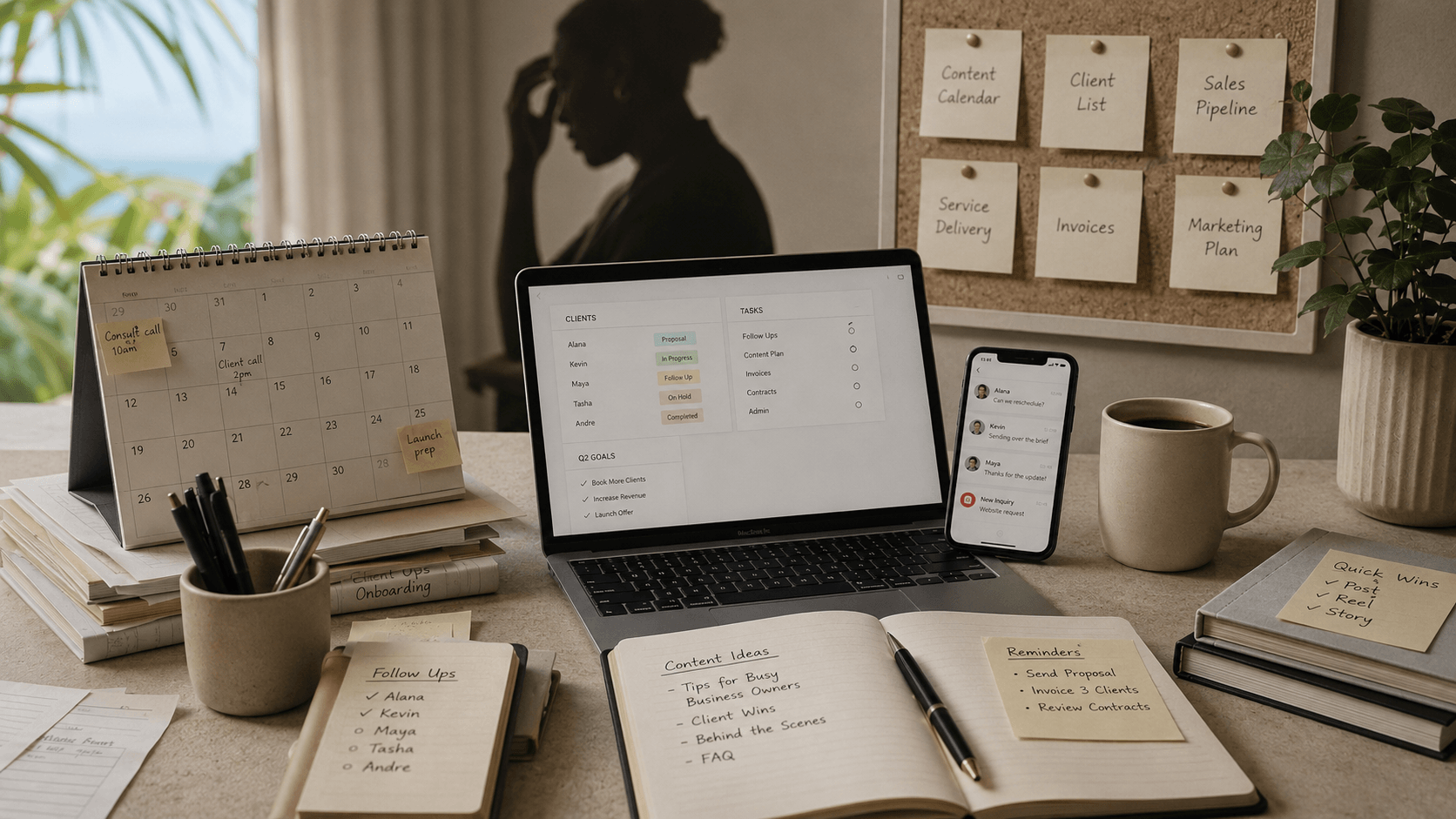
A lot of small businesses are not actually running on proper systems.
They are running with the owner as the system.
The owner has to remember who asked for prices, who needs a follow-up, which client needs a reminder, who booked last month, who might come back, who asked about a package, who said they would check their schedule, and who still needs the link.
Until the owner forgets. Then things slip.
And when things slip, the owner often blames themselves. They think they need to be more disciplined, more organized, more responsive, more consistent, more “on top of things.”
Sometimes discipline helps. But sometimes the real issue is not discipline. It is design.
A business that depends on one person remembering every next step is not designed to hold much weight. Even if that works for a while, is it sustainable?
The quick diagnostic
Here is a simple way to tell whether your business has a system or whether it mostly has you holding everything together.
When someone enquires, do they enter a clear process, or do they enter your memory?
When someone books, does the business automatically know what should happen next, or do you have to manually remember every message?
When a client leaves, is there a plan to bring them back, or do you hope they remember you?
When someone asks the same question for the tenth time, is there a smoother way to answer it, or are you still typing the whole thing again?
When you are tired, busy, sick, travelling, booked back-to-back, or just mentally full, does the business still move?
Think hard on these questions.
A real system gives the business structure even when the owner is not juggling all moving parts.
Burnout is not always a personality problem
I take this seriously because I know what burnout feels like.
I know what it feels like to be capable, responsible, high-functioning, and still hit a wall because too much is sitting on you for too long.
That is one reason I care so much about systems. Not as a trendy business word. Not as some polished consultant talking point. Systems make the difference because human beings have limits.
You can care deeply and still forget; be smart and still get overwhelmed; be talented and still drop things when everything depends on you manually catching every ball.
That does not make you lazy. It makes you human.
A lot of service business owners are carrying far too much in their heads. You are not only doing the service. You’re also handling enquiries, bookings, follow-up, reminders, customer questions, social media, payments, content, reviews, admin, staff, suppliers, and sometimes family life on top of it.
Then you wonder why the business feels heavy.
Of course it feels heavy. The backend is a person. The backend is you.
Every era has tools
This is where I think some of the AI and automation conversation gets misunderstood.
I am not an AI fanatic or advocate. I am not interested in using AI just because it is new, shiny, or trendy.
I believe in using the tools of the era you are living in.
But why? Simply because history shows that the tools of the era make life easier. History also shows us that those who struggle most tend to be the ones stuck trying to use tools of eras gone by, to solve current-era problems.
In an agricultural era, land, labour, tools, water, animals, crop knowledge, and access to production shaped who could build wealth and stability. In the industrial era, machines, factories, energy, transport, manufacturing systems, and capital changed what was possible. People who understood how to use those tools could produce more, move faster, scale further, and compete differently.
Now we are in a digital and AI-supported era.
That does not mean every business needs to become a tech company, or that every owner needs to obsess over every new platform. It doesn’t even mean AI solves every problem.
It means the tools available to us have changed.
And when the tools change, the workload can change too.
You could cut down a tree with a chainsaw, an axe, or a knife. Technically, all three are tools that could work. But the effort, time, risk, and result will not be the same. Right? Imagine how long it would probably take you to get the job done using a knife… exactly.
Business works the same way.
You can manage enquiries, follow-up, reminders, client lists, FAQs, bookings, and re-engagement manually. Many people do.
But that does not mean it is the smartest use of your energy.
If you are constantly working IN the business, you have no time to work ON the business.
You’re also constantly trading time for money, and that keeps you burnt out, stuck in a state of stress, instead of being able to enjoy your business and run it from a settled place instead of always putting out fires.
Modern tools should reduce the wrong kind of work
The goal is not to remove the human from the business.
That is not what I believe in.
For service businesses especially, the human experience is still a huge differentiator, especially as we move deeper into AI and tech. People still want care. They still want nuance and trust, and to feel like someone understands what they need.
The problem is that many owners are using their human energy on the wrong things, so by the time a prospect arrives expecting a human experience, the business owners have no energy for them.
Answering repeat questions all day, juggling admin tasks, and sending out the same information is not the best use of your time and energy.
The human parts should be focused on the relationship, the service, the strategy, the quality, the decision-making, and the parts that actually require care and judgment.
The predictable parts should have support.
That is where AI, automation, and proper digital systems can help. Not as a replacement for your brain, but as a way to stop taxing your brain with things that should not need to live there in the first place.
The owner as the whole backend
Here is what “no system” often looks like in a service business.
The Instagram bio says one thing. The booking platform says another. The latest prices are in a flyer from three months ago. The owner answers common questions manually in DMs. Follow-up happens when someone remembers. Past clients are sitting in a booking platform or old messages, but no one is actively re-engaging them. Referrals happen randomly. Reviews are appreciated but not consistently requested. Specials go up when the owner gets time to post.
From the outside, the business may look active.
Behind the scenes, the owner is holding the whole thing together with memory, effort, and urgency.
That can work for a season. It is also exhausting.
It creates a ceiling… a bottleneck. The business can only move as fast as the owner can personally remember, reply, post, chase, update, and follow through.
At some point, the owner does not need another motivational quote.
They need a better operating structure.
What a good system should actually do
A useful system does not need to be complicated. In fact, complicated systems often fail because no one uses them properly anyway.
The first layer should make the business easier to run.
It should help people understand what you offer and what to do next. It should capture enquiries instead of letting them stay buried in scattered inboxes. It should organize leads and clients so you can see who needs attention. It should answer repeated questions more efficiently. It should send reminders and follow-ups where appropriate. It should help past clients come back instead of letting every booking become a one-off.
That might involve AI. It might involve automation. It might involve a better website, clearer service pages, a CRM, better booking links, email or SMS follow-up, WhatsApp workflows, forms, tags, pipelines, or a cleaner content-to-booking path.
The tool depends on the problem, so start with the bottleneck.
You need to ask yourself the right questions: What keeps slipping? What keeps repeating? What keeps stressing you out? Where are people getting confused? What do they keep asking about? Where are leads getting lost? Where are you doing the same manual task over and over?
That is where the system should begin.
Technology should serve the business, not distract from it
One mistake I see people make is chasing tools before they understand the real issue.
They hear about AI, so they want AI. They hear about automation, so they want automations. They hear about funnels, dashboards, CRMs, bots, and workflows, then suddenly the business has more tools but not more clarity.
That is not the goal here. A messy business with more software is still messy.
The point is to use the right tool for the right job.
If customers keep asking the same five questions, the solution may be clearer service information, a better FAQs section, a pre-filled response, or an AI-assisted chat flow.
If leads keep disappearing in DMs, the solution may be a proper lead capture process.
If clients book once and never return, the solution may be post-service follow-up, rebooking reminders, birthday offers, referral prompts, or a re-engagement sequence.
If the owner keeps forgetting who needs what, the solution may be a simple pipeline or dashboard that makes the invisible visible.
None of that is about being fancy.
It is about making the business less dependent on constant manual effort.
The needed shift
The switch is not from human to robot.
It is from everything depending on the owner to the business having structure.
That is a very different thing, isn’t it?
A good system does not make a service business colder. Done well, it can make the business feel more attentive.
People get responses faster. They get clearer information. They get reminders. They get followed up with. They get invited back. They are not left wondering what to do next because the owner was too busy to reply.
The owner also gets relief.
Not because there is nothing left to do, but because the work is no longer scattered across memory, inboxes, screenshots, and mental notes.
Remember, a business should not only move when the owner remembers to move it.
Build for the era you are in
Every generation has had to learn the tools of its time.
Does that mean every tool is worth using? Does it mean every trend deserves your attention, or you abandon common sense? No.
It means you cannot build a modern business while refusing to examine whether your current tools and systems are strong enough for the workload you are carrying.
If you are still running the entire backend from memory, WhatsApp, Instagram, scattered notes, and “I’ll remember later,” there is probably a better way.
Not a perfect way or an overnight fix. A better way.
And sometimes that is enough to change how the business feels.
Ready to stop being the whole backend?
If your business feels like it only works when you are personally remembering, replying, chasing, posting, and following up, that is worth looking at.
You may not need a massive tech stack. You may need a cleaner system around the work you are already doing.
You can send me a message or book a call from the link below.
Start by telling me what is weighing on you most right now.
Is it too many repeated questions? Messy follow-up? Leads slipping away? Clients not returning? Too much admin? No clear process after someone enquires?
All you need is that first action step towards turning things around so you finally have peace of mind and can exit that “fight or flight” mode.
The goal is not to automate your entire business for the sake of it.
It is to stop using your memory, energy, and nervous system as the operating system.
You are not supposed to be the whole backend.
Your business needs a better system.
If you’d like to connect, find me on my socials: Direct.me/teriallori